The Real ROI of Technology Investments
By Len Wierzbicki, Head of Strategy & Marketing, Badger Technologies
Most organizations still treat ROI as a simple financial equation. But modern technology investments create value in ways that extend far beyond cost savings or revenue lift. Real ROI emerges from capability building, speed, risk reduction, and operational transformation.
ROI Begins With the “Why,” Not the “What”
Many companies measure ROI by evaluating tools instead of outcomes. Technology does not create value on its own. It creates value only when aligned with core business needs like revenue growth, cost efficiency, customer experience, and scalability.
A BairesDev analysis notes that leaders struggle because technology impact is often unclear. They write, "Technology ROI measures the financial and operational impact of any company’s tech investments. It compares the gains from tech adoption to its costs and helps businesses assess profitability".
This reinforces the idea that ROI is not a feature of the technology itself. It is a function of strategy alignment.
Time to Value: The Hidden Multiplier of ROI
Speed of impact is becoming more important than depth of impact. Time to Value (TTV) determines how fast an organization realizes benefits from its investment.
Deloitte’s 2024 research on digital transformation shifts states, "Year over year analysis reveals material changes in technology investment priorities, reflecting the increasing urgency for faster, more measurable impact".
This indicates that organizations now optimize for agility and rapid capability deployment. Faster TTV creates competitive advantage long before traditional ROI is fully realized.
Productivity Gains Are Real, Measurable, and Undervalued
Productivity gains from technology adoption are often underestimated because organizations struggle to measure intangible improvements such as reduced errors, improved decision quality, and streamlined workflows. As Resolution IT explains, "Tangible benefits are measurable, such as increased revenue or cost savings.
Intangible benefits might include improved customer satisfaction or employee productivity". These benefits compound over time, even though they may not appear directly in traditional financial reporting.
The Value of Repeatability vs Manual, Human Driven Work
A critical but frequently overlooked driver of ROI is the repeatability that technology enables. Manual, human driven processes are inherently inconsistent due to fatigue, variation in technique, or subjective decision making. Technology delivers repeatable execution and uniform output quality, which dramatically increases operational reliability and reduces error rates.
Research across scientific and industrial fields reinforces this. The National Academies note that "reproducibility is one of the pathways by which the scientific community confirms the validity of a new scientific discovery," highlighting the importance of consistent, repeatable processes for reliable outcomes. In industrial environments, robotics research from Standard Bots defines repeatability as the ability to return to the same position or execution path under the same conditions and stresses its importance by noting that even a 0.1 millimeter deviation can cause costly defects in manufacturing environments.
This same principle applies in business operations. Technology-driven processes generate:
- Consistent output quality
- Lower error rates
- Predictable cycle times
- Higher throughput with fewer interruptions
- Reduced cost of rework and exception handling
Repeatability also accelerates scalability. Once a workflow is automated, it can execute thousands of times with no degradation in quality. This is not possible with human-centered processes that vary across individuals and conditions. In addition, repeatability strengthens compliance. Automated systems execute controls identically every time, which reduces noncompliance risk and improves audit readiness.
In short, the repeatability of technology amplifies productivity by producing uniform, reliable, and error-resistant outcomes that human processes cannot sustain at scale. This becomes a measurable ROI driver when organizations factor in reduced defects, fewer manual interventions, and increased speed of execution.
Risk Reduction: The Most Overlooked ROI Driver
Risk reduction rarely appears in traditional ROI models, but research shows it is a major value creator. Organizations that modernize systems often do so to reduce regulatory exposure, eliminate cyber vulnerabilities, and prevent operational disruptions.
AWS sponsored research from the Enterprise Strategy Group states, "AI, security, and cloud are perceived as the highest performing tech investments" and identifies risk mitigation as a major contributor to ROI outcomes.
This validates that risk reduction is not a soft benefit. It is a measurable return tied to business continuity and long-term resilience.
ROI Compounds Over Time
Unlike physical assets, digital capabilities create compounding effects. Once teams adopt new tools, each additional enhancement accelerates impact.
A study on intelligent automation from the International Journal of Engineering Technology Research and Management found that companies deploying intelligent automation "see an average return on investment between 30 percent and 300 percent with a median ROI of 150 percent within the first year of deployment".
This high variance demonstrates that ROI is nonlinear. Adoption momentum, process harmonization, and cloud-based deployment all produce compounding returns.
The Modern ROI Equation
A contemporary view of ROI must capture both financial and nonfinancial value. A more complete equation looks like this:
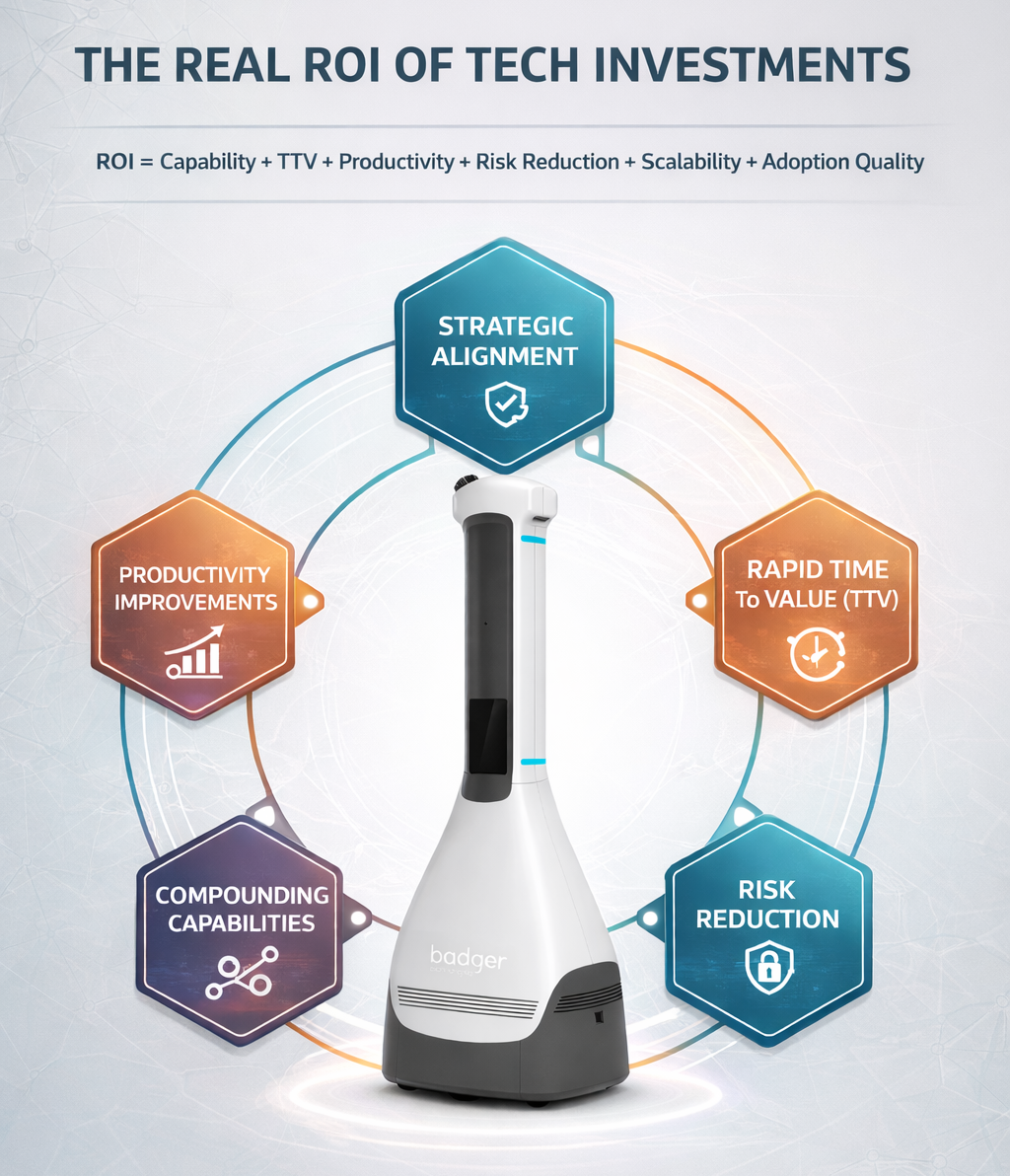
ROI = Capability Gain + Time to Value + Productivity Lift + Risk Reduction + Scalability + Adoption Quality
Research supports this broader view. For example, Caisy’s 2025 guide notes that "ROI is not just about the financial bottom line. It is also about operational efficiency" and emphasizes the importance of balancing tangible and intangible benefits.
This supports the need for a multi-dimensional ROI framework.
Adoption is the Ultimate ROI Catalyst
Even the best technology delivers zero ROI if adoption is low. Research consistently shows that adoption maturity is a defining variable.
The Enterprise Strategy Group stresses that "misalignment abounds when it comes to assessing tech adoption maturity" and that this misalignment is a leading cause of underperformance in ROI outcomes.
This makes adoption less of a training issue and more of a leadership alignment imperative.
Conclusion
The true ROI of technology investments extends beyond traditional accounting measures. Organizations that win treat technology as a strategic asset, not a discretionary expense. Research consistently reinforces that ROI is driven by:
- Strategic alignment
- Rapid time to value
- Productivity improvements
- Risk reduction
- Compounding digital capabilities
- Strong adoption practices
Technology ROI is ultimately a leadership issue. It is about clarity of purpose, disciplined execution, and the ability to turn digital capabilities into business outcomes.
📄 Download the Digital Teammate Fact Sheet (PDF)
Schedule a Live Demo!
About Badger Technologies
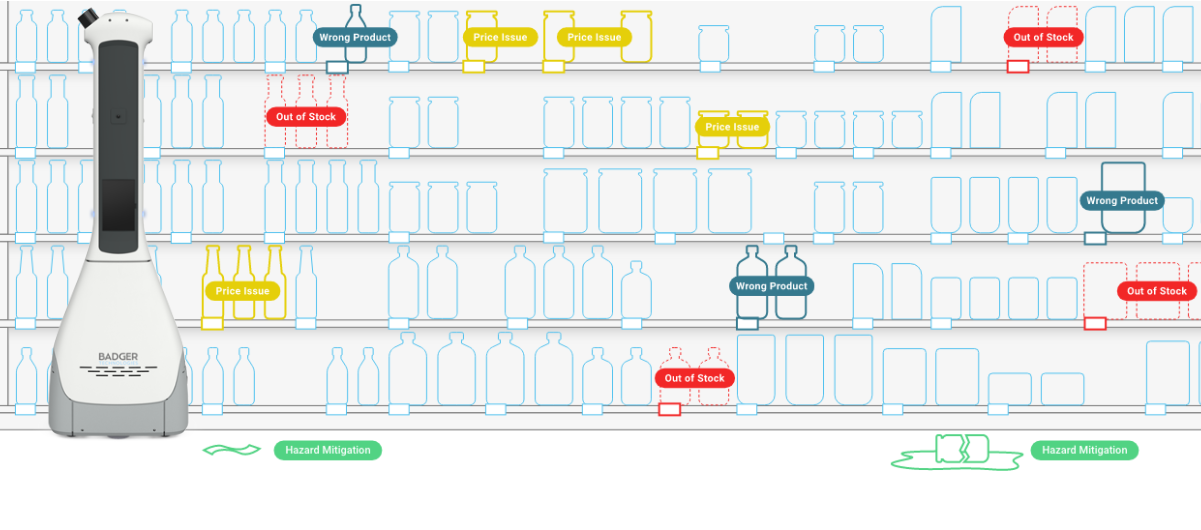
Badger Technologies, a product division of Jabil, is a leader in retail automation and artificial intelligence solutions. Its autonomous robots and digital teammates help retailers improve on-shelf availability, pricing accuracy, planogram compliance, and store safety.
With deployments across grocery, building supply, and other high-SKU retail environments, Badger Technologies provides retailers with real-time data and actionable insights that drive measurable results. Headquartered in Nicholasville, Kentucky, the company is committed to helping retailers build smarter, safer, and more efficient stores.