From Insight to Impact: How Retailers Turned Visibility Into Execution in 2025
By Len Wierzbicki, Head of Strategy & Marketing, Badger Technologies
As retailers reflect on 2025, one theme stands out across nearly every conversation.
Insight was not the limiting factor. Execution was.
Over the past year, retailers expanded access to data across forecasting, inventory, merchandising, pricing, and store operations. More information reached more people, faster than ever before. Yet performance outcomes varied widely from one retailer to the next.
Some organizations translated insight into faster replenishment, steadier on-shelf availability, and stronger store conditions. Others continued to experience daily friction despite having access to the same categories of data.
The difference was not how much insight retailers had. It was how effectively that insight could be trusted, prioritized, and acted upon inside the store.

Why Insight Alone Was Not Enough
In many stores, teams were already aware of the issues they faced.
- Out-of-stocks were familiar.
- Pricing inconsistencies were expected.
- Misplaced items were common.
- Planogram drift was part of daily reality.
- Safety risks emerged throughout the day.
What slowed execution was not awareness. It was uncertainty.
Too often, insight arrived disconnected from real shelf conditions. Exception lists require verification. Alerts lacked context. Associates spent time investigating instead of executing. Store managers relied on walking the floor to confirm what systems suggested.
This created a familiar pattern. Insight triggered activity. Activity consumed labor. Execution lagged behind the need.
Retailers learned an important lesson in 2025. Detection does not drive performance. Confidence does.
When Visibility Became Actionable
Retailers that improved execution focused on reducing the distance between insight and reality.
They examined where system expectations routinely diverged from shelf conditions and how often store teams were forced to reconcile that gap manually. As visibility improved, execution patterns began to change.
Replenishment shifted from reactive to targeted. Teams focused on the most impactful gaps first instead of chasing suspected issues.
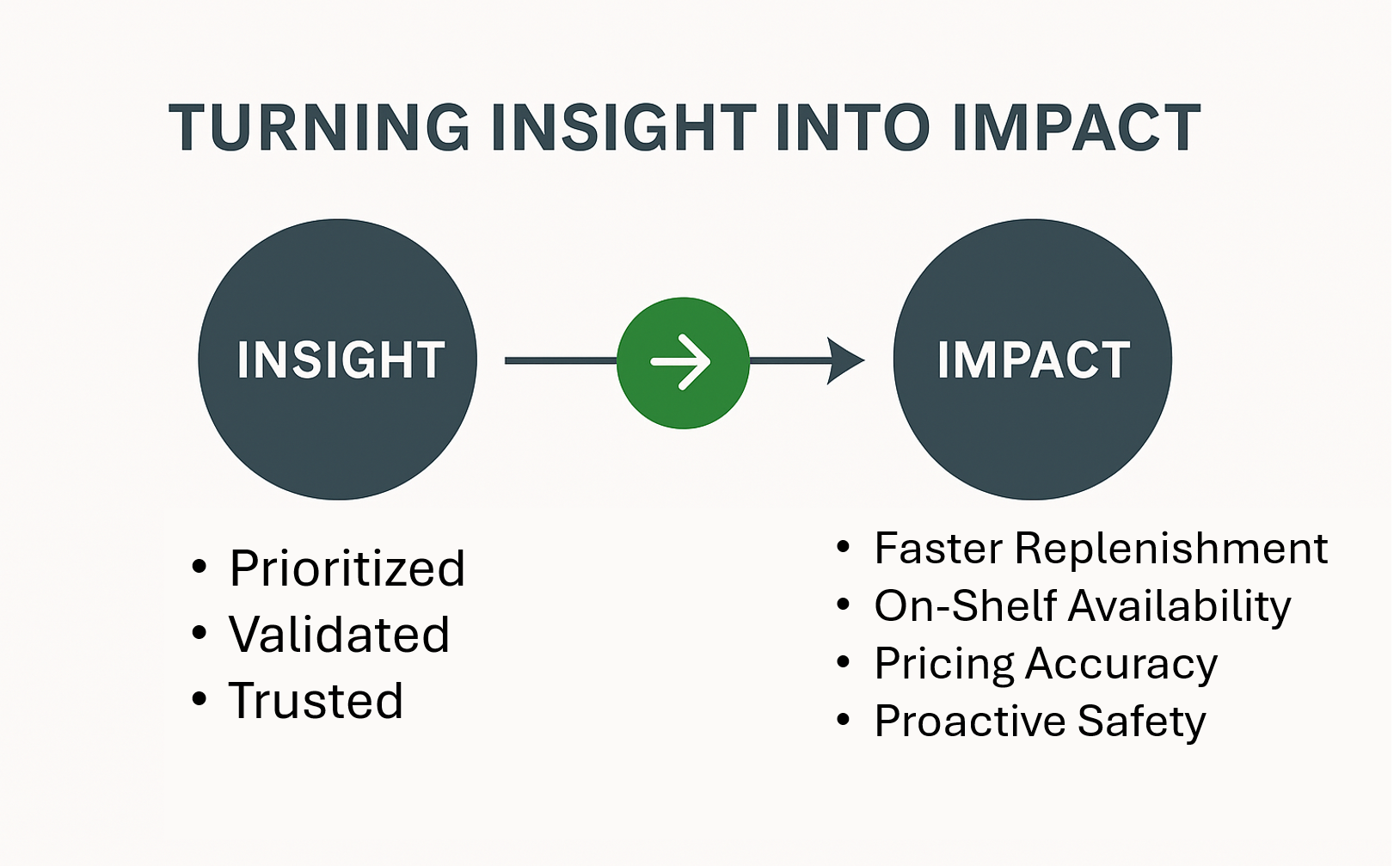
- On-shelf availability stabilized as action was based on verified conditions rather than assumptions.
- Pricing discrepancies were corrected earlier, protecting shopper trust.
- Search time declined as placement accuracy improved.
- Safety issues were identified sooner, supporting more proactive store environments.
What changed was not the volume of information, but the reliability of it.
Store teams no longer had to ask whether the data reflected what they would encounter on the floor. They knew where to focus and why it mattered.
Prioritization Turned Insight Into Impact
One of the clearest lessons from 2025 was that retailers do not struggle with awareness. They struggle with prioritization.
Not every exception affects performance equally. Not every alert deserves immediate attention. Teams perform best when direction is clear and uncertainty is removed.
Retailers that made progress delivered insight that was grounded in actual shelf conditions, validated rather than assumed, and ranked by operational and shopper impact.
This shift reduced noise and allowed store teams to spend more time executing work that moved the business forward.
Entering 2026 With Greater Control
As retailers prepare for 2026, expectations are rising across omnichannel fulfillment, pricing integrity, labor productivity, store conditions, and retail media performance.
Across all of these areas, the requirement is the same.
Retailers cannot operate confidently without accurate visibility into what is happening inside their stores.
Leaders are now asking more disciplined questions: Which insights consistently lead to action? Where does visibility break down during the day? How often do teams need to verify data before acting? What would change if shelf conditions were understood continuously, not periodically?
The answers to these questions are shaping how retailers think about operational readiness for the year ahead.
As NRF Approaches
As NRF approaches, the tone of retail conversations is shifting. Retailers are less focused on what is new and more focused on what reliably works inside the store.
The most meaningful discussions are no longer about adding insight, but about reducing friction between data and execution.
Leaders want to know which signals hold up under pressure, which insights translate into action, and which investments actually improve daily performance. In that context, the ability to move confidently from insight to impact is becoming a defining theme as retailers enter 2026.
From Insight to Impact
The most successful retailers in 2025 learned that insight only becomes valuable when it enables confident execution.
They learned that...
- Performance improves when visibility reflects reality.
- Prioritization matters more than volume.
- Store teams perform better when clarity replaces guesswork.
As retailers enter 2026, those who consistently convert insight into impact will be better positioned to reduce friction, improve consistency, and deliver stronger experiences for both associates and shoppers.
That transition, from knowing to doing, is where execution finally accelerates.
📄 Download the Digital Teammate Fact Sheet (PDF)
Schedule a Live Demo!
About Badger Technologies
Badger Technologies, a product division of Jabil, is a leader in retail automation and artificial intelligence solutions. Its autonomous robots and digital teammates help retailers improve on-shelf availability, pricing accuracy, planogram compliance, and store safety.
With deployments across grocery, building supply, and other high-SKU retail environments, Badger Technologies provides retailers with real-time data and actionable insights that drive measurable results. Headquartered in Nicholasville, Kentucky, the company is committed to helping retailers build smarter, safer, and more efficient stores.