What Data Actually Matters as Retailers Enter 2026
By Emil Martinez, CEO, Badger Technologies
Over the past two decades, I have had the privilege of working with retailers across the world in roles focused on retail data, syndicated measurement, global standards, and digital transformation. From my time at ACNielsen, NPD, IRI, and GS1 to my years overseeing large scale innovation programs at TCS, I have seen nearly every version of retail data maturity. I have seen what works, what does not, and where even the most sophisticated strategies break down.
Across all of those experiences, one insight has remained consistent. Retailers have more data than they have ever had, but the data they rely on most often fails them at the moment they need it. Not because it is incomplete or outdated, but because it does not reflect what is happening on the shelf.
The shelf is where shoppers make decisions. It is where sales are won or lost. It is where inventory precision matters. It is where price accuracy influences trust. And it is where the complexity of a modern store is most visible.
As we approach 2026, retailers are beginning to recognize that the path to better performance does not start with collecting more data. It starts with understanding which data actually matters.
The Shelf Has Always Been the Blind Spot
Throughout my career, I have seen companies invest heavily in forecasting engines, replenishment systems, merchandising tools, and increasingly sophisticated analytics platforms. These systems have improved planning in significant ways. But they were never designed to capture the live, unpredictable nature of the store environment.
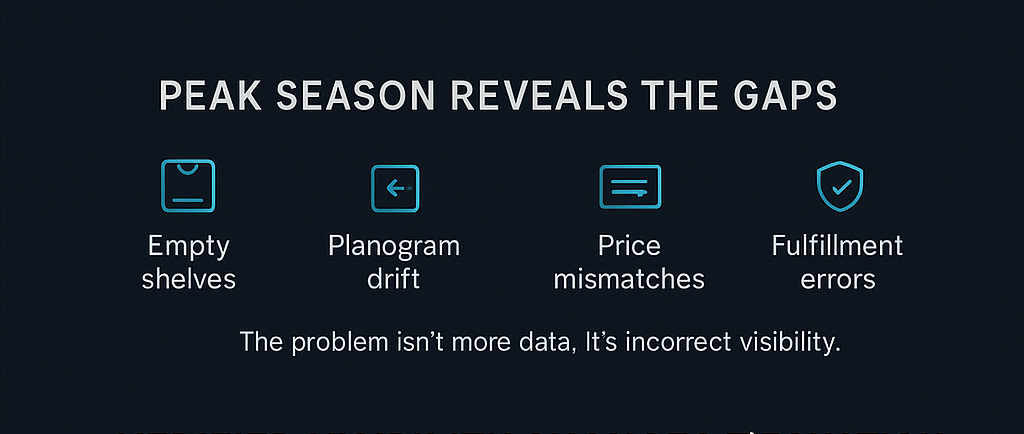
Customers move items. Associates relocate product to make room for new freight. Promotional displays sell down faster than expected. Prices are updated in the system before they are updated on the tag.
Planograms drift as stores work to keep up with daily volume. And on the busiest days, shelves can change dramatically in minutes.
By midmorning, many stores are already operating in a reality that does not match what their systems believe.
This is not a failure of effort. Store teams work exceptionally hard. It is a failure of visibility. Retailers have been building plans on top of assumptions and then sending store teams to bridge the gap.
As someone who has spent a significant portion of my career helping retailers improve their data foundations, I believe we are now at a turning point. For the first time, retailers have the ability to validate shelf conditions continuously and incorporate that truth into their daily decisions.
December Makes the Gaps Impossible to Ignore
One of the reasons this moment is so important is that December exposes the limits of traditional data more clearly than any other time of year.
- Shelves empty faster.
- Shoppers behave less predictably.
- Out of stocks appear before teams expect them.
- Planograms drift as product movement accelerates.
- Price tags fall behind the pace of updates.
- Online orders strain inventory accuracy.
Search time increases because items are not where the system believes they should be.
As I visited retailers during peak season, I heard the same story in every store. System data showed one version of reality. The shelf showed another. Associates spent time verifying, investigating, correcting, and searching instead of executing. And leaders had difficulty gauging how well the store was performing until they saw it for themselves.
What stood out most was that the problem was never a lack of information. The problem was the lack of information that reflected what teams and shoppers were actually experiencing.
This is when the industry began to shift its focus from quantity of data to quality of visibility.
The Signals That Actually Matter in Modern Retail
During conversations with retailers, several themes rise to the top when discussing data that truly influences daily performance. Here is what we've learned.
Real Availability
Not what the system believes is in the building, but what is actually accessible on the shelf at the moment the customer arrives. The difference between the two determines lost sales, fulfillment accuracy, and shopper trust.
Accurate Placement
Misplaced items are one of the most common causes of execution friction. They slow replenishment, disrupt pick paths, and create uncertainty for both associates and customers.
Pricing Integrity
Shoppers pay close attention to price. Even a small mismatch can drive frustration or lost confidence. Retailers understand that pricing precision is a direct reflection of their brand.
Presentation Health
Low facings, shifting facings, and unexpected gaps influence how shoppers perceive the store and how quickly teams identify issues.
Safety Awareness
Spills, obstructions, and floor hazards occur throughout the day. Identifying them early protects both customers and employees.
Why Verified Visibility Changes the Equation
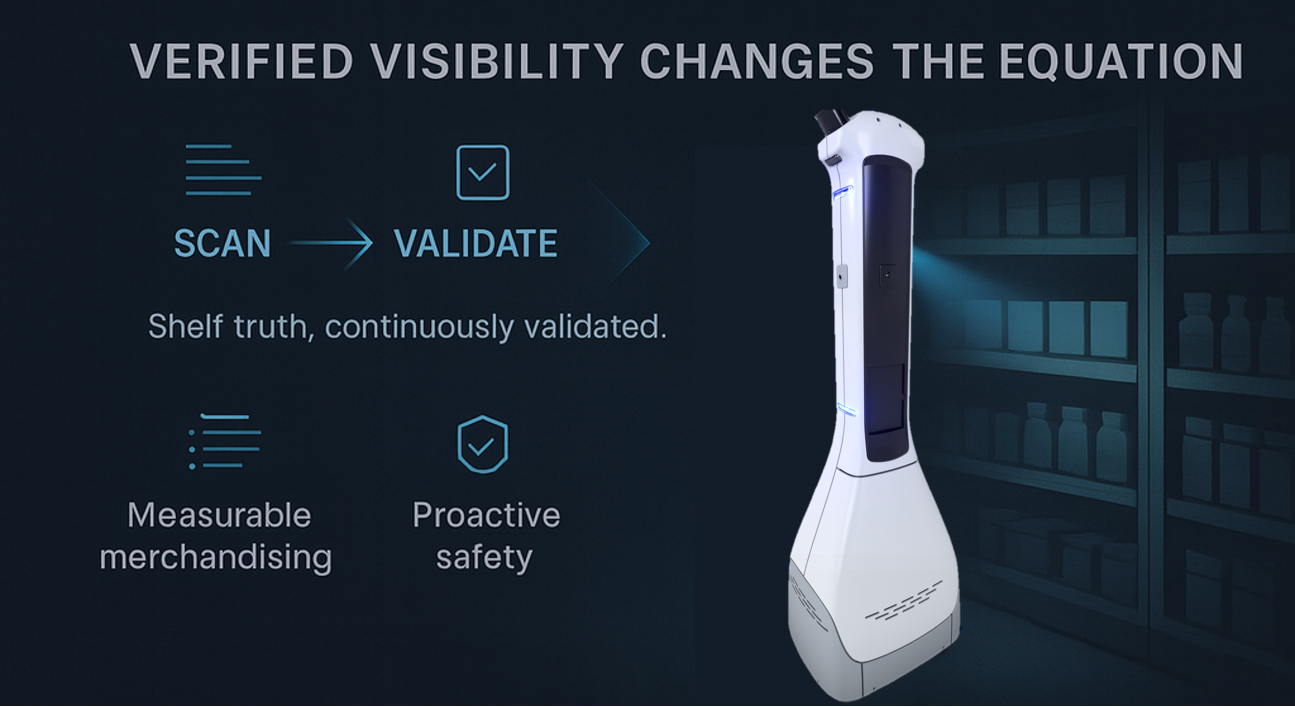
Verified visibility is the ability to validate shelf conditions continuously and integrate that truth into the systems and workflows that depend on it.
Across the industry, retailers are beginning to rely on continuous, automated visibility to strengthen accuracy, safety, and on-shelf availability. At Badger Technologies, our next-generation digital teammates support this shift by scanning shelves automatically for availability, placement, pricing, and safety indicators.
At Badger Technologies, our digital teammates scan shelves automatically for availability, placement, pricing, and safety indicators. They cross check those conditions against digital records. They identify exceptions that matter, organize them by priority, and help store teams focus on the highest impact work.
What makes this powerful is not the volume of information, but the accuracy and timing of it. Store teams begin the day with clarity instead of questions. They understand what is real, what is missing, and what requires immediate attention. They no longer rely on guesswork to determine where to start.
Verified visibility strengthens nearly every operational process.
- Replenishment becomes faster and more precise.
- BOPIS picking becomes more reliable.
- Merchandising integrity becomes measurable.
- Price accuracy becomes easier to maintain.
- Safety programs become more proactive.
- Store leadership gains a clearer view of performance throughout the day.
Having spent more than twenty years helping retailers improve their data foundations, I can say that verified visibility brings a level of stability and predictability that traditional systems have never been able to achieve on their own.
What This Means for Retailers Entering 2026
The retailers I speak with today are focused on improving consistency across their store fleets, strengthening the accuracy of their omnichannel operations, reducing avoidable loss, and creating a better experience for both associates and customers.
They understand that none of these goals can be achieved with assumptions or outdated views of the shelf. They need data that reflects the moment. They need data that is trusted. They need visibility that holds up as the store changes in real time.
Verified visibility gives retailers this foundation. It connects enterprise intelligence with physical truth. It creates a continuous feedback loop between what systems expect and what stores deliver. It reduces operational volatility and gives leaders confidence that the conditions shaping performance are understood and addressed.
Retailers who enter 2026 with this capability will be better positioned to respond to shopper behavior, reduce friction for store teams, and strengthen performance across every operational metric that matters.
A Future Built on Better Visibility
As I reflect on the past twenty years, the most significant advances in retail have always come from reducing the gap between what retailers believe is happening and what is actually happening. Verified visibility closes that gap in a way the industry has been working toward for decades.
The future of retail will belong to the companies that understand their stores at a deeper level, respond faster to real conditions, and build operations around data that is both accurate and actionable.
The path forward is clear. Better decisions begin with better visibility. And better visibility begins at the shelf.
📄 Download the Digital Teammate Fact Sheet (PDF)
Schedule a Live Demo!
About Badger Technologies
Badger Technologies, a product division of Jabil, is a leader in retail automation and artificial intelligence solutions. Its autonomous robots and digital teammates help retailers improve on-shelf availability, pricing accuracy, planogram compliance, and store safety.
With deployments across grocery, building supply, and other high-SKU retail environments, Badger Technologies provides retailers with real-time data and actionable insights that drive measurable results. Headquartered in Nicholasville, Kentucky, the company is committed to helping retailers build smarter, safer, and more efficient stores.