Why Retail’s Execution Gap Is Really a Leadership Conversation
By Mike Graen
Retail has never had more data at its disposal.
And yet one of the most important questions in the store still often goes unanswered with confidence: Is the product actually available on the shelf right now?
Most organizations today operate with real-time dashboards, advanced analytics, and a growing array of tools designed to improve execution inside the store. For many retailers, visibility is no longer the primary constraint.
Yet in conversations with retail leaders, a familiar frustration continues to surface:
- Out-of-stocks linger longer than expected.
- Pricing issues are often discovered by shoppers.
- On-hand in the system does not always translate to on-shelf availability for customers.
- Safety risks compete with dozens of other priorities.
- Store leaders spend more time confirming conditions than correcting them.
Across roles, formats, and retail segments, the same question keeps coming up:
Why does execution still feel harder than it should?
A shopper moment that explains the problem
This weekend, I ran into a perfect example.
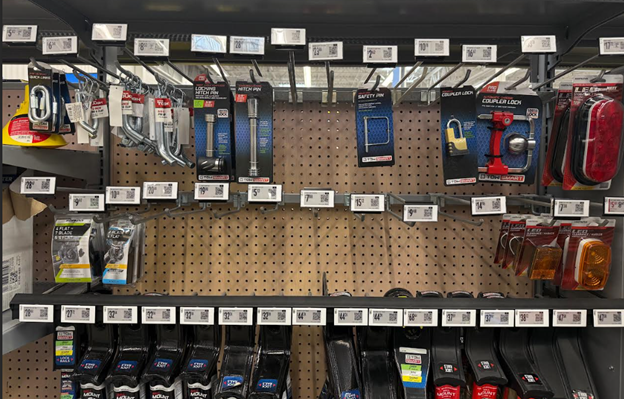
I needed a specific part for my RV. I went to the shelf expecting it to be there. Instead, I found an empty spot and the familiar disconnect between what the store should have and what a shopper can actually buy.
That moment is small, but the pattern is not. And it plays out every day across categories and retailers. When availability breaks down, it is rarely because teams are not working hard. It is because the store is managing too many competing signals, with too little shared clarity about what to act on first.
When visibility outpaces focus
One pattern shows up consistently in these conversations. As insight has increased, focus has become harder to maintain.
Inside stores, teams are surrounded by signals. Alerts, reports, and task lists compete for attention. When priorities are unclear or information feels incomplete, execution slows, not because people disengage but because they hesitate.
Work shifts toward verification.
- Aisles are re-walked.
- Reports are cross-checked.
- Decisions wait until someone feels confident enough to move.
This behavior is understandable. Acting on partial or conflicting information carries risk, especially in environments where time, labor, and expectations are already stretched.
What often gets labeled as an operational issue is, at its core, a leadership one.
Execution is an organizational behavior
Execution does not break because people stop caring.
It breaks when organizations struggle to align attention.
What gets acted on immediately?
What requires confirmation?
What can wait until tomorrow?
These are not system decisions. They are leadership decisions, whether they are made intentionally or by default.
When teams lack shared clarity about what matters most, caution becomes normalized. Over time, that caution shows up as delay, rework, and frustration, both for store teams and for the shoppers they serve.
Execution, in this sense, is not just a process. It is an organizational behavior shaped by priorities, trust, and focus.
Why this matters now
As retailers plan for the years ahead, execution capacity is emerging as a defining constraint.
Labor remains tight.
Expectations for availability, accuracy, and safety continue to rise.
Stores are being asked to do more with limited time and attention.
In this environment, the conversation is beginning to shift. Leaders are spending less time asking for more insight and more time asking how focus is directed, protected, and reinforced inside the store.
The organizations making progress are not necessarily the ones with the most advanced platforms. They are the ones that create alignment around a smaller set of trusted signals and empower teams to act with confidence instead of second-guessing.
A conversation worth continuing
The next phase of retail transformation will not be driven by technology alone. It will be shaped by leadership decisions about prioritization, trust, and how work actually gets done inside stores.
That makes execution more than an operational topic.
It makes it a leadership conversation.
And it is a conversation worth continuing; across retailers, brands, solution partners, and the leaders navigating change every day.
📄 Download the Digital Teammate Fact Sheet (PDF)
Schedule a Live Demo!
About Badger Technologies
Badger Technologies, a product division of Jabil, is a leader in retail automation and artificial intelligence solutions. Its autonomous robots and digital teammates help retailers improve on-shelf availability, pricing accuracy, planogram compliance, and store safety.
With deployments across grocery, building supply, and other high-SKU retail environments, Badger Technologies provides retailers with real-time data and actionable insights that drive measurable results. Headquartered in Nicholasville, Kentucky, the company is committed to helping retailers build smarter, safer, and more efficient stores.